Railenko
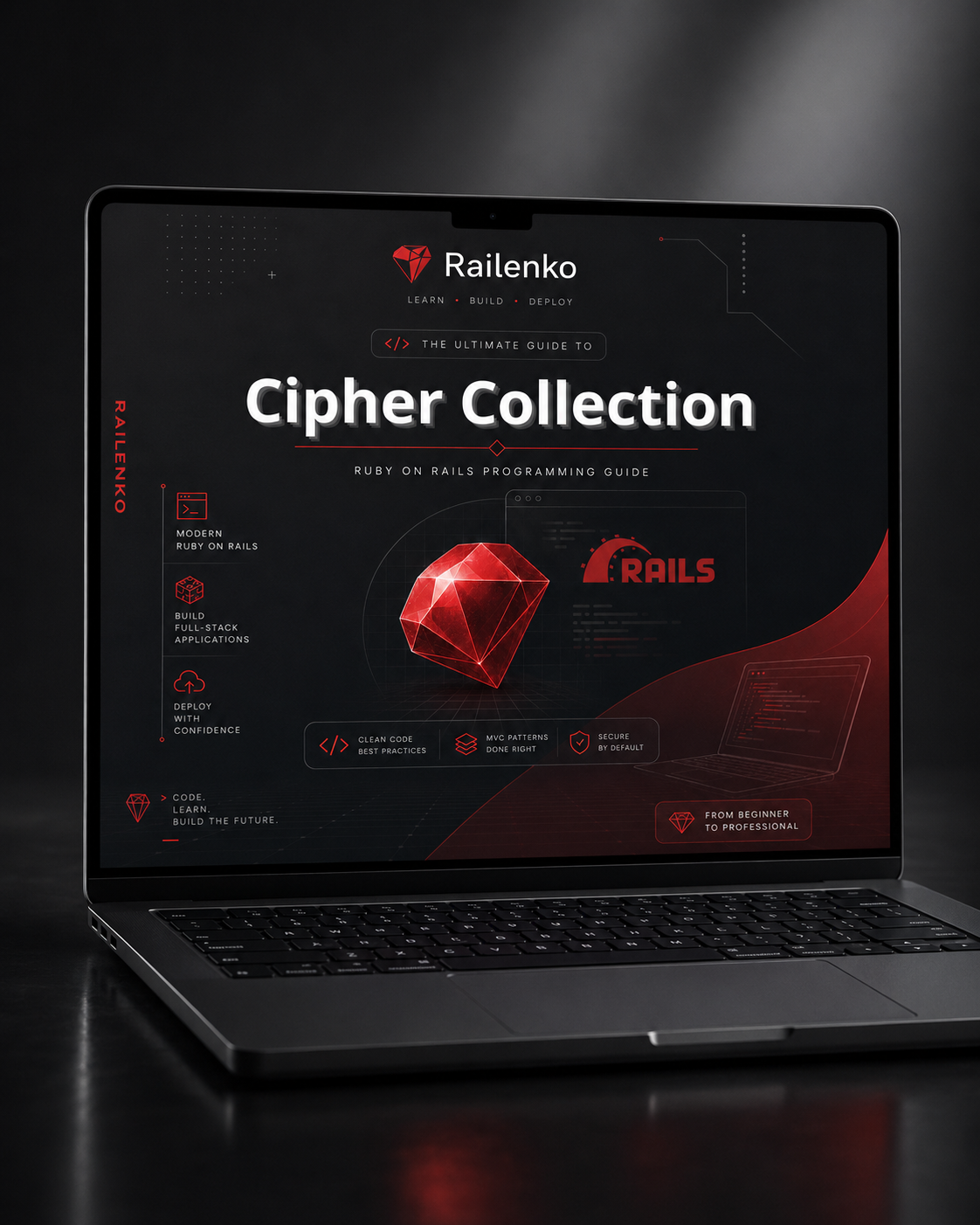
Cipher Collection
Cipher Collection
Couldn't load pickup availability
- 📁 Digital file available after purchase
- ♾️ Long-term availability
- 🔒 Secure checkout
- 🗓️ Content updated in 2026
Self-paced learning overview
1. Problem Statement
As Ruby in Rail programming examples become more layered, learners may read the code but still miss the meaning behind its structure. A route, method, variable, or page section may look familiar, yet its role inside the full learning project may not be clear at first glance. Learners can also struggle when code contains several related parts that depend on one another. Without a structured reading method, project examples can feel like a set of disconnected symbols instead of a readable system. Cipher Collection was created for learners who want to decode project logic carefully and turn unclear code sections into understandable learning material.
2. Solution
Cipher Collection teaches learners to read Ruby in Rail programming examples as connected messages rather than isolated fragments. The course introduces a structured interpretation method based on names, routes, values, methods, page sections, and review notes. Learners study how to identify clues inside code and connect them with the wider project context. Each module uses practical examples where learners trace one idea through several files and explain what happens at each stage. This helps create a more thoughtful way of reading project logic and preparing for more detailed Railenko materials.
3. What’s Inside
Cipher Collection includes learning materials focused on code interpretation, project tracing, and structured explanation. The course begins with an orientation module that introduces the idea of reading code like a message. Learners are shown that every name, file, route, method, and value can give information about the role of a code section. The goal is not to guess, but to observe clues and connect them step by step.
The first main section focuses on naming clues. Learners study route names, variable names, method names, file names, and section names. The course explains how names can guide reading when they are written with care, and how unclear names can make a learning example harder to follow. Learners compare several naming examples and describe how each name shapes their understanding of the code.
The second section focuses on tracing values. Learners follow a value from the moment it appears in a controller action or method to the moment it is shown in a page section. This includes single values, lists, grouped values, and prepared collections. The course explains how to mark the starting point, identify the preparation stage, and locate the display point. These exercises help learners understand that data movement is not random; it follows a path that can be read.
A separate part of Cipher Collection is dedicated to route interpretation. Learners study how routes can act as signs inside a project. A route can show what page is being requested, which controller action is involved, and what kind of content may appear next. The course includes practical examples where learners match routes with actions and then connect those actions with views. Each example is followed by a short written explanation.
Cipher Collection also includes a module on controller action reading. Learners examine how actions prepare values, choose data, organize small lists, and pass information toward a page. The course explains how to separate the role of an action from the role of a view. This is useful because many learners mix preparation and display in their mind. The module gives practical tasks where students describe what an action does in plain technical wording.
The next section focuses on views and page output. Learners study how prepared values appear inside page sections, lists, labels, and repeated blocks. The course explains how to read a page section from top to bottom and identify which parts are static text and which parts come from project logic. Learners compare page examples where the connection is clear with examples where the connection needs closer reading.
Another important part of Cipher Collection is relationship mapping. Learners are given small project maps that connect a route, a controller action, prepared data, a view, and a review note. They use these maps to follow the logic of the example. This helps learners see the project as a connected structure rather than a group of separate files.
The course also includes interpretation tasks. A learner may receive a code section and answer questions such as: What is the main role of this method? Where does this value appear later? Which name gives the clearest clue? What part prepares the data? What part displays it? These questions are written to support practical reading and careful explanation.
Cipher Collection includes comparison exercises with coded examples. Learners review two versions of the same project section. One version may contain unclear names, repeated values, or a crowded page area. Another version may show a more organized arrangement. The learner compares both versions and writes a short explanation of what changed. This builds a habit of noticing structure through details.
A dedicated module focuses on hidden assumptions in learning code. Some code examples appear simple, but they may rely on a value being present, a list being prepared, or a route pointing to the correct action. Learners study how to identify these assumptions and describe them. This helps them read beyond the visible line and understand what the project expects at that point.
Cipher Collection also contains review notes for each module. These notes summarize key ideas in short, practical paragraphs. They help learners return to the topic after completing a task. The notes cover naming clues, value tracing, route reading, action reading, page output, and relationship mapping.
The course includes practical writing prompts. Learners are encouraged to describe project behavior in their own words. For example, they may write a short explanation of how a value moves from a controller action to a page, or how a route connects to a view. This written practice supports clearer technical communication without relying on inflated wording.
By the end of Cipher Collection, learners should have more practice reading Ruby in Rail programming examples with attention to clues, structure, and relationships. The course does not make broad claims about personal outcomes. It provides organized materials for learners who want to decode project logic, trace code behavior, and explain what they see in a structured way.
4. Who Is This For?
Cipher Collection is for learners who already understand basic Ruby in Rail programming structure and want to read project examples with more attention. It is suitable for students who can recognize routes, actions, methods, and views, but want a clearer method for interpreting how those parts work together.
This tariff is useful for learners who enjoy careful reading and written explanation. It fits those who want to study code not only by writing it, but also by describing what each part is doing.
Cipher Collection can also support learners who are preparing for more layered Railenko collections. It gives them a practical method for tracing values, reading names, mapping relationships, and explaining code behavior in a structured format.
5. What You’ll Learn
- How to read code as a connected project message
- How names can give clues about code purpose
- How to trace values from preparation to page output
- How to connect routes with controller actions and views
- How to describe the role of a controller action
- How to separate data preparation from page display
- How to read page sections with static and dynamic parts
- How to use project maps for relationship tracing
- How to compare two versions of the same code section
- How to identify repeated values and crowded page areas
- How to notice hidden assumptions in learning examples
- How to write short technical explanations in plain language
- How to review Ruby in Rail programming examples with a structured reading method
6. Refund Note
Railenko includes a 30-day refund window for Cipher Collection. If the course materials do not match your learning needs, you may submit a refund request within 30 days of purchase according to the store policy.
Do I need previous coding knowledge?
Do I need previous coding knowledge?
Some tariffs are designed for early learners, while others go deeper into project structure, logic, and code organization. Each tariff description explains who it is made for.
What is included in each Railenko tariff?
What is included in each Railenko tariff?
Each tariff includes learning materials built around Ruby in Rail programming, with written modules, code examples, practice tasks, and structured explanations.
Share